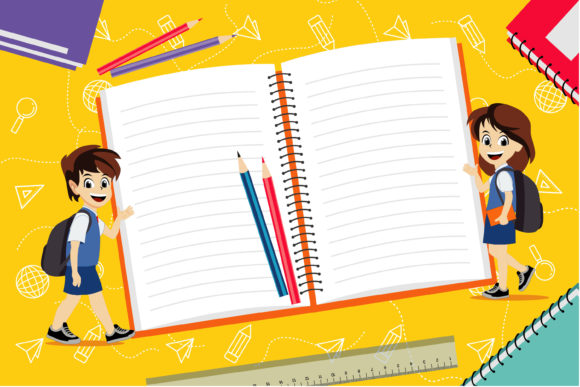
Back to School with Students Vector
When you search for Back to School with Students Vector illustrations, you are looking at more than just clip art. These vectors typically depict groups of students walking, studying, or gathered near school buildings, often with backpacks, books, and seasonal elements like autumn leaves. The availability in JPG, EPS, AI, and CDR formats means the same design can be used across print, web, merchandise, and presentations. Despite this apparent simplicity, many people download or purchase these files only to run into avoidable problems. Understanding a few critical details before you commit to a file can save you time, money, and frustration.
The core appeal of these vectors lies in their flexibility. A well-made illustration of students heading back to school can serve a school website, a promotional flyer for a tutoring service, a social media post for a parent group, or even a t-shirt design for a fundraiser. Yet that same flexibility is exactly where most people make their first mistake.
Choosing the Wrong File Format for the Task
One of the most common errors is picking a format based on convenience rather than purpose. A JPG is easy to preview and upload, but it is a raster format with a fixed pixel grid. If you try to resize a JPG version of a Back to School with Students Vector illustration to fit a banner, you will see pixelation and blur. The AI, EPS, and CDR files, on the other hand, are vector formats. They use mathematical paths instead of pixels, which means you can scale them from a business card size to a billboard without any loss of quality.
The misunderstanding often happens because beginners see the same image previewed in all four formats and assume they are interchangeable. They are not. A JPG is useful only for quick previews, web use at exact dimensions, or when you have no editing software. For any resizing, professional printing, or further customization, you need AI, EPS, or CDR.
How to avoid this mistake: before you download, ask yourself what you are actually going to do with the file. If you only need a static image for a single web post, a high-resolution JPG may be fine. If you are designing a poster, flyer, banner, or any print material, go straight for the vector formats. Check which software you own: Adobe Illustrator opens AI and EPS well, CorelDRAW handles CDR natively, and many free tools can import SVG or EPS with varying success.
Overlooking Licensing Terms and Usage Rights
Another area where even experienced designers slip up is assuming all Back to School with Students Vector files come with blanket permission to use them however they like. The truth is that licensing varies widely. Some files are royalty-free and allow commercial use, while others are restricted to personal or educational projects only. A vector you buy from a marketplace may come with a limit on the number of copies you can print, or it may forbid using the illustration as a logo or trademark.
The practical result of ignoring licensing is wasted time and potential legal risk. Imagine designing a full promotional campaign around a vector, only to discover later that the license prohibits resale or redistribution of the design on merchandise. You would have to redo the entire project or scramble to purchase an extended license.
Better approach: read the license terms before you hit download. Look for phrases like "commercial use," "personal use only," "no redistribution," or "attribution required." A reputable marketplace will clearly state whether the file can be used in products for sale, in digital templates, or in print runs over a certain quantity. If the terms are vague or missing, choose another vector. There are plenty of high-quality options with clear licensing.
Ignoring Color Mode: RGB vs. CMYK
This detail is technical but has a huge impact on the final look of your project. Most Back to School with Students Vector files are created in RGB color mode, which is ideal for screens and digital displays. However, commercial printing services typically use CMYK. If you take an RGB vector straight to a printer, the colors may shift dramatically. A bright, warm yellow backpack can become dull or muddy in print.
Many people do not realize this until they see the printed result and wonder why the design looks wrong. The correction requires converting the color mode in your vector editing software, and not all file formats handle that conversion equally well. AI and EPS files are easier to convert without loss, while JPGs offer very limited control.
What you should do: confirm whether the vector file is provided in both color modes. If only one version is available, and you plan to print, choose a vector format like AI or EPS so you can convert it to CMYK yourself. If you are only using the design on a website or social media, RGB is perfectly fine. Knowing your end destination prevents the disappointment of mismatched colors.
Underestimating the Importance of Style Consistency
When you browse through different Back to School with Students Vector illustrations, you will notice a wide range of artistic styles. Some are flat and minimalist, others highly detailed with shading, and some are cartoon-like with exaggerated features. A common mistake is to mix and match these styles within the same project. A flat, modern vector of students sitting at desks does not pair well with a highly textured, hand-drawn-style school bus.
The result looks disjointed and unprofessional, even if each individual illustration is high quality. This matters because consistency is one of the main factors that makes a design look polished and intentional. A mismatched set of visuals can confuse your audience and weaken your message, especially if you are creating a branded piece like a school newsletter or a tutoring center brochure.
Solution: before you choose a vector, look at the whole collection or the artist's portfolio. Many designers offer sets of Back to School vectors that share the same line weight, color palette, and level of detail. Downloading a coordinated set will save you hours of editing and re-coloring. If you must combine vectors from different sources, prepare to spend time adjusting colors, strokes, and proportions to make them look like they belong together.
Neglecting to Check Scalability and Detail
Vector files are scalable in theory, but not all vectors are created equal. Some illustrations contain a high number of anchor points and complex gradients that become problematic when scaled extremely large or very small. If you scale a poorly constructed vector down to stamp size, thin lines may disappear, and small details like facial features or text on a book cover may become illegible. If you scale it up, you might notice uneven curves or jagged edges that were not visible at the original size.
This problem is common when you download a vector that was built quickly or without professional standards. Beginners often assume that the term "vector" automatically guarantees perfect scaling, but the quality of the underlying paths matters a lot.
Practical check: open the file in your editing software and zoom in to 200% or 400%. Look at the edges of shapes. Are they smooth? Are there unnecessary points that create bumps? Try reducing the size to see if important details still hold. If the file has a lot of overlapping shapes or ungrouped elements, it may be more trouble than it is worth. Invest in vectors that are cleanly constructed, with manageable layers and well-defined paths.
Overlooking the Need for Customization
Many people download a Back to School with Students Vector and use it exactly as is, without adjusting anything. While that can work in a pinch, it often results in a generic look. A stock vector that appears in hundreds of other projects does not make your material stand out. Worse, if you use it without any modification, it may feel mismatched to your specific brand colors, fonts, or message.
Avoiding this mistake is not difficult. The vector formats AI, EPS, and CDR are designed for editing. Spend time changing the colors to match your brand palette. Reposition elements to fit your layout. Remove characters or objects that are not relevant to your specific audience. Add your own text, logo, or background elements. Even small changes, such as adjusting the skin tones or clothing colors of the students, can make the vector feel personal and intentional.
If you are not comfortable editing vectors yourself, many designers offer customization services, or you can learn the basics through tutorials. The investment in a small amount of editing is worth the improvement in relevance and originality.
What to Check Before You Download or Buy
To avoid these mistakes entirely, develop a simple checklist before you commit to a Back to School with Students Vector file:
- File format availability: Make sure the download includes the format you need for your workflow, especially if you require AI, EPS, or CDR for editing.
- License terms: Confirm that the license covers your intended use, whether that is personal, educational, commercial, or resale.
- Color mode: Check if the file is RGB, CMYK, or both, and verify that it matches your output medium.
- Style consistency: If you need multiple vectors, choose a set or collection that shares a cohesive look.
- Scalability and quality: Review the vector paths for smoothness and detail, and test scaling in your software.
- Customization ease: Look for well-organized layers and grouped elements that make editing straightforward.
- Preview accuracy: Trust but verify that the preview image matches what you actually receive in the vector file.
Taking ten minutes to go through these checks can prevent hours of rework and frustration later. It also ensures that your project benefits from the real strength of vector graphics: flexibility, quality, and professional results.
Building Better Projects with the Right Vector
Back to School with Students Vector illustrations offer a fast, affordable way to add visual interest to a wide range of materials. The key is to approach them with a clear understanding of what you are getting and what you need. By choosing the correct file format, respecting licensing, paying attention to color mode, maintaining style consistency, verifying scalability, and investing in customization, you turn a simple download into a powerful asset for your project.
Whether you are a teacher creating classroom materials, a small business owner promoting a back-to-school sale, a blogger writing about academic tips, or a freelance designer working on a client project, the same principles apply. The vector itself is just the starting point. Your decisions about how to select, check, and adapt it determine whether the final result looks haphazard or polished. The right vector, used well, helps you communicate clearly and professionally. The wrong choice, no matter how cheap or convenient, can undermine the very message you are trying to deliver.
Keep these guidelines in mind next time you search for a Back to School with Students Vector in JPG, EPS, AI, or CDR format. Your future self, and your audience, will appreciate the difference.